
 Install
Home A Markup.io alternative
A Markup.io alternative for website feedback

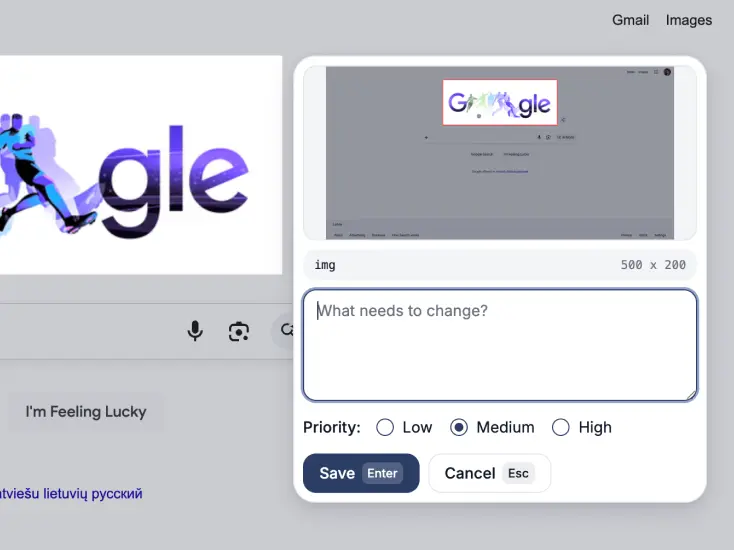
Website Feedback Tool is a Chrome extension that lets you drop comments straight onto a live web page — a free, browser-based alternative to Markup.io. If you've been using Markup.io to collect review comments on a site and the per-month price stopped making sense for how often you actually use it, this does the same core job from your browser.
Both tools exist because written feedback about a web page is miserable to act on. "The spacing under the hero looks off on mobile" costs three messages to locate. A pin on the actual element costs none. Here's how the two line up.
What Website Feedback Tool does
You open the extension on whatever page you're looking at and start marking it up. Nothing to upload first, no project to create.
- Click an element to pin a note to it, or drag a box around a broken area.
- Record a short clip when the problem only makes sense in motion.
- Everything collects into one review you share as a link, or export to PDF/HTML.
- Push the whole batch into Claude Code or Codex and let your AI agent do the fixes.
The full walkthrough of what it does is on the feedback tool for website page.
How it compares to Markup.io
Markup.io is a hosted review platform: you create a MarkUp from a URL or a file, and share a link with reviewers. Website Feedback Tool runs as an extension on the page itself. The short table:
| Website Feedback Tool | Markup.io | |
|---|---|---|
| Runs as | Chrome extension, on the page you're already viewing | Hosted platform — you create a MarkUp from a URL or file |
| Reviews | Live web pages | 30+ file types — websites, images, PDFs, video |
| Works on | Any page in your browser — live, staging, behind a login | URLs and files you load into the platform |
| Reviewers need an account | No | No — guests can comment on a shared link |
| Turns feedback into | Code fixes, straight into Claude Code / Codex | Comments and tasks inside the workspace |
| Price | Free | Pro $79/mo; Enterprise on request; 14-day trial |
Markup.io is a solid, mature product and its plans change over time — check their pricing page for current details before you decide.
Where the two really differ
Some things are genuinely the same. Both pin comments to a spot, both let outside reviewers comment without signing up, and both give you one place to read the results. The differences come from one being an extension and the other a hosted workspace:
- It runs on the actual page. Because it's an extension, it works on whatever is in your tab — a live site, a staging URL, a page behind a login. Markup.io loads the URL into its own viewer, which suits publicly reachable pages.
- Nothing to create first. Install once and comment. There's no MarkUp to set up and no workspace to organise before the first note.
- It's free. The whole loop costs nothing. Markup.io's paid tier starts at $79/mo after the 14-day trial.
- It goes straight into code. Push a review into Claude Code or Codex and your AI agent makes the fixes — the review stops being a to-do list and becomes a diff.
If your reviews mostly end up as developer work, the developer and QA page walks through how a review turns into fixes.
Where Markup.io might still be the better pick
It wins in plenty of situations, and pretending otherwise would be useless to you. Reach for Markup.io when:
- You review more than web pages — it handles images, PDFs and video in the same place, which an on-page extension doesn't.
- You need one workspace where every review is stored, organised in folders and searchable months later.
- Your company needs SSO, SAML or SOC II documentation to approve a tool at all.
- You want managed share links with control over who can open what.
- Your reviewers are on browsers or locked-down machines where an extension can't be installed.
For the everyday case — a designer catching layout bugs, a founder reviewing a landing page, an agency collecting client notes on a staging site — running on the page is less friction. Designers in particular tend to prefer it; there's a short write-up on the designers page.
Switching from Markup.io
There isn't much of a migration. Install the extension, open the page you were reviewing, and pin your first comment. No workspace to rebuild and no reviewers to re-invite — a live review takes about a minute to start.
Worth keeping in mind: anything already stored in your Markup.io workspace stays there. Export or finish the reviews that matter before you let a paid plan lapse.